Article
Rooms Where Nothing Happens
On waiting rooms, loading screens, and the strange productivity of the moments we are forced to do nothing at all.
This is placeholder content, written to exercise the site’s typography and article anatomy. It will be deleted before launch.
There is a kind of room that exists only to be left. Waiting rooms, departure lounges, lobbies, the corridor outside an exam hall — spaces designed for the specific purpose of holding people who would rather be somewhere else. Nobody decorates them with conviction. Nobody remembers them fondly. And yet I have started to suspect that these rooms do more work on us than the rooms we actually mean to be in.
The suspicion began with a simple observation: the quality of my thinking seems to be inversely proportional to how much I have arranged for thinking to happen. Give me a desk, a notebook, two hours blocked in a calendar, and a document titled “Ideas,” and I will produce, reliably, almost nothing. Put me in a plastic chair under fluorescent light with a dead phone and a forty-minute wait, and somewhere around minute twelve the interesting thoughts arrive, uninvited, like cats.
This is not a new observation about the world. People have been having their best ideas in showers and on walks for as long as there have been showers and walks.1The shower and the walk get all the credit in the folklore of ideas, which is unfair to the queue. The shower at least has warm water going for it. The queue produces the same effect with no amenities whatsoever, which should count for more, not less. But I think the standard explanation — that the mind wanders usefully when it is not being supervised — misses something specific about the waiting room in particular. A walk is chosen. A shower is pleasant. A waiting room is neither, and its unpleasantness is the active ingredient.
The economics of forced idleness
Consider what a wait actually costs. The time itself is the visible price, the one we complain about. But the real transaction is stranger: a wait confiscates your agenda. Whatever you had planned to optimize, produce, or respond to is suspended by an authority you cannot negotiate with — the queue, the delay, the system. For the length of the wait, you are relieved of the obligation to be effective.
That relief turns out to be expensive to buy voluntarily. I can decide to do nothing for forty minutes, but the decision leaks. Some part of me audits the idleness, checks whether it is working, wonders if this is the good kind of rest or the bad kind. Chosen idleness comes with a supervisor. Imposed idleness does not. The queue is not my fault. The delay is not a character flaw. And so, absolved, the auditing part of my mind finally goes quiet — and the other parts, it turns out, had things they were waiting to say.
We are kept from our best thinking not by a shortage of time but by a surplus of intention.
I don’t fully believe that sentence — it has the suspicious neatness of something written to be quoted — but I don’t fully disbelieve it either. There is a version of attention that only becomes available when nothing can be done with it. The waiting room manufactures that attention as a by-product, the way a fire gives off light because it is busy giving off heat.
A field guide to waits
Not all waits are equal, and it is worth being precise about the differences, because only some of them produce the effect I am describing. A rough taxonomy, from my own unscientific field observations:
| Kind of wait | Typical length | Agency left to you | Texture |
|---|---|---|---|
| The queue | 12 min | None — the line moves when it moves | Shuffling, communal, mildly resentful |
| The delay | 40 min | None, plus false hope of updates | Announcements, recalculations, sighing |
| The buffer | 8 min | Full — you arrived early on purpose | Smug, fragile, easily filled |
| The handoff | 20 min | None — someone else is finishing something | Doorways, corridors, half-presence |
The queue and the delay are the potent ones. The buffer — time you banked by arriving early — almost never works, because it was chosen, and chosen idleness, as established above, arrives pre-supervised. The handoff is a special case: you are technically waiting but socially on call, ready to be needed at any second, and that readiness keeps the useful part of the mind from ever fully standing down.2Anyone whose work involves being “just five minutes away” from being needed knows that those five-minute intervals cannot be used for anything, including rest. The handoff wait is all of the cost of waiting with none of the release.
The common thread in the potent waits is the surrender of agency. The wait must be imposed, its length must be uncertain, and there must be nothing you can legitimately do to shorten it. The moment any of those three conditions fails, the wait collapses into ordinary time — schedulable, optimizable, and mentally supervised like everything else.
What the loading screen took away
Software used to make us wait honestly. Progress bars crawled. Dial-up modems performed their little overture. The machine said, plainly: this will take a while, and there is nothing you can do about it. Those pauses were tiny waiting rooms, scattered through the day, and we resented every one of them.
So we engineered them away — and where we couldn’t, we papered over them. The modern loading screen does not admit to being a wait. It shimmers with skeleton content, spins a tasteful spinner, streams in a first meaningful paint.3Skeleton screens are the honest lie of the genre: gray rectangles shaped exactly like the content you are about to get, so that the wait is experienced as almost-having rather than not-yet-having. It is genuinely clever design. That is rather the problem. Latency was not eliminated; it was disguised, specifically so that our attention would never be released. An app that lets your mind leave, even for three seconds, risks losing you to another app. The war on waiting was never really about our time. It was about our exits.
The result is a day with no gaps in it. Not because the gaps are gone — the elevator still takes eleven seconds — but because every gap now has a designated filler, resident in a pocket, charged and ready. The eleven seconds get spent on nothing at all: a lock screen glanced at, a notification triaged, a feed nudged half a screen further. The gap is successfully bridged, and whatever used to happen in the unbridged version happens nowhere.
I notice this most on the days when it fails to happen — when the phone is dead, or forgotten, or deliberately left behind. The first minutes of an unfilled wait are genuinely unpleasant, a low-grade withdrawal that presents as boredom but feels closer to itch. Then the itch passes, and what is left is a kind of roominess I have otherwise engineered out of my life. Thoughts get longer. They connect to each other across larger gaps. The waiting room, having taken my agenda, quietly hands me a different one.
The recovery curve
Here is the shape of my suspicion, drawn rather than measured. After a wait ends, attention does not snap back to full strength; it recovers along a curve, and the curve seems to depend on what the wait contained.
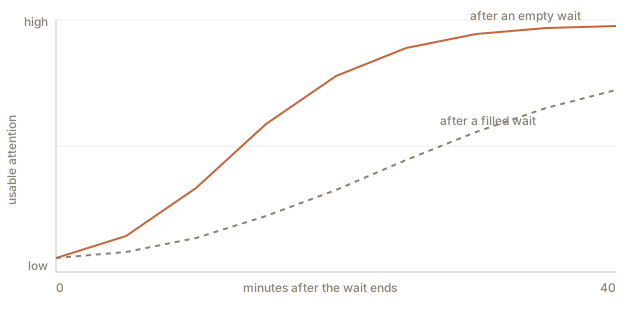
After an empty wait — one endured without a screen — I seem to return to work already warmed up, as though some part of the thinking started early and merely needed a desk to land on. After a filled wait, the opposite: the feed’s texture lingers, and the first half hour of work has the consistency of wet cardboard. The sketch above is what that difference feels like from the inside. I would be delighted to learn that someone has measured this properly, and only mildly embarrassed if the measurement disagreed with me.
What I am fairly sure of is the asymmetry: the filled wait costs something after it ends. The scrolling was supposed to be free — it occupied time that was already forfeit. But attention is not a faucet; it is a pot that has to reheat. Fill the wait, and you pay for the filling during the next thing you actually cared about.
Waiting together
There is also a social version of all this, and it may be the older and better one. A railway platform ten minutes before an announced delay resolves is one of the most quietly companionable places on earth. Everyone present has had their agenda confiscated by the same authority. Nobody is performing busyness, because there is no meeting to be late for that anyone can do anything about. Strangers talk on delayed platforms in a way they never talk on punctual ones.
The waiting room used to be one of the last places where people of different sorts sat in the same silence — different ages, different jobs, different reasons for being there, all demoted to the same plastic chairs. Some of what we call the loneliness of modern life may just be the disappearance of these rooms: places where you were thrown together with people you did not choose, with nothing to do but be mildly, mutually present.
The phone dissolved this too, of course. A waiting crowd is now a set of private booths that happen to share furniture. But the dissolution is shallower than it looks — kill the network for ten minutes and the booths reopen into a room. The capacity for communal waiting is intact; it is merely outbid, eleven seconds at a time.
None of which is an argument for inefficiency, exactly. I do not miss dial-up. I do not want longer queues, and neither does anyone who has stood in a real one with somewhere to be. The argument is narrower: the waits that remain — and some always remain — are not dead time unless we kill them. They are the last unscheduled rooms in the schedule, and what happens in them appears, in my experience, precisely nowhere else.
Keeping a few rooms empty
The obvious move here would be to end with a system: scheduled idleness, phone-free hours, a ritual of manufactured boredom with a name and a streak counter. I am suspicious of that move, partly because I have made it before in other areas of life and watched the system become one more thing to administer, and partly because it misses the point established above — that the potency of the wait comes precisely from its not being chosen, supervised, or optimized.
You cannot schedule an ambush. What you can do, maybe, is stop neutralizing the ambushes that daily life still manages to spring. The queue at the pharmacy. The fifteen minutes when the meeting before yours runs long. The airport gate, after the boarding-group theater has been watched and there is nothing left to monitor. These are the last few naturally occurring rooms where nothing happens, and the only discipline required is negative: do not reach for the filler. Let the itch arrive, and let it pass.
I want to be careful not to claim too much. Most waits will still produce nothing but the wait. The pharmacy queue is not a monastery, and boredom is not a productivity technique wearing a robe. The claim is smaller: that a life with no unfilled moments in it is running with one of its senses switched off, and that switching it back on costs nothing except the mild discomfort of standing somewhere with empty hands.
The rooms where nothing happens were never really empty. They were where the unscheduled thoughts lived. We have been demolishing them, gap by gap, eleven seconds at a time — and unlike most demolitions, this one reverses the moment you put the phone back in your pocket and simply wait.
Footnotes
Note 1
The shower and the walk get all the credit in the folklore of ideas, which is unfair to the queue. The shower at least has warm water going for it. The queue produces the same effect with no amenities whatsoever, which should count for more, not less. ↩
Note 2
Anyone whose work involves being “just five minutes away” from being needed knows that those five-minute intervals cannot be used for anything, including rest. The handoff wait is all of the cost of waiting with none of the release. ↩
Note 3
Skeleton screens are the honest lie of the genre: gray rectangles shaped exactly like the content you are about to get, so that the wait is experienced as almost-having rather than not-yet-having. It is genuinely clever design. That is rather the problem. ↩